Size and print get almost all the attention when a bakery orders custom donut boxes, but the structure quietly does the hard work. How a box folds, locks, and carries its load decides whether a dozen glazed donuts survive a delivery driver’s back seat and how many minutes your staff spend snapping boxes together during the morning rush. The styles below all show up in donut catalogs under similar photos, yet they behave differently once there is weight inside. Here is how the common structures compare and which one to specify for the way you actually sell.
The one-piece tuck-top: the default donut box
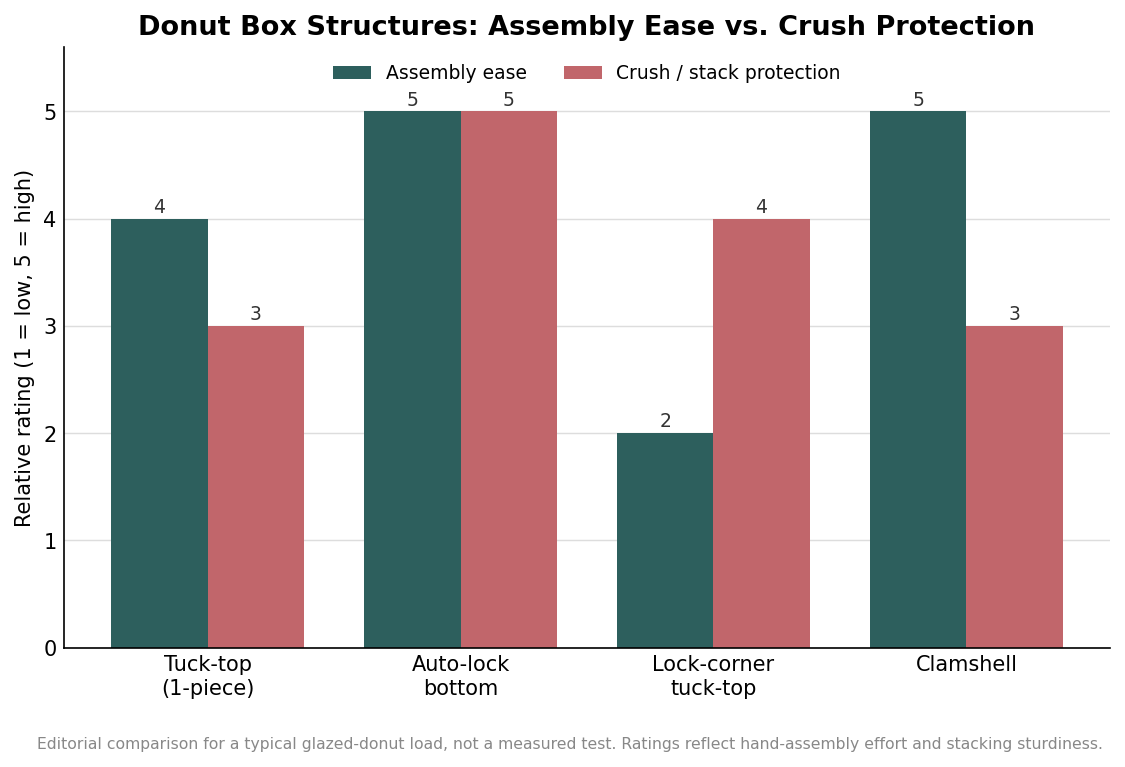
Most bakery boxes you have handled are a one-piece tuck-top, often a roll-end style where the walls fold up from a flat blank and a front flap tucks in to close. It ships and stores flat, assembles by hand in a few folds, and costs the least per unit, which is why it dominates counter service and short trips home. The tradeoff is rigidity: with a full dozen inside and nothing locking the base, the bottom can bow if the box is carried one-handed or stacked two high. For a half-dozen going a few blocks it is more than enough; for catering runs it is the weakest of the group.
Auto-lock bottom: built for weight and speed
An auto-lock bottom, also called a crash-lock or one-two-three bottom, arrives pre-glued so the base snaps into a locked, load-bearing floor the moment you square the box. That single feature does two useful things at once. It gives you the sturdiest bottom in the lineup, which matters for heavier assorted dozens and for stacking, and it is the fastest to set up at volume because there is no folding sequence to teach a new hire. You pay a little more per unit for the glued construction, but a busy shop usually earns that back in assembly labor and in fewer crushed orders.
Lock-corner tuck-top: rigid walls without glue
A lock-corner tuck-top uses interlocking tabs at each corner to build rigid side walls with no adhesive at all. The result is a strong, clean-walled box that presents well and holds its shape, sitting between the plain tuck-top and the auto-lock bottom on sturdiness. The cost is assembly time: those corners are folded and locked by hand, which is fine for a boutique operation packing gift dozens but slows down a high-volume morning. Choose it when presentation and a glue-free build matter more than raw setup speed.
Window boxes: selling the donut through the lid
A die-cut window turns the box into a merchandising tool, letting a decorated dozen sell itself on a shelf or in a grab-and-go cooler. The window is covered with a clear film, most commonly PET or polypropylene for clarity and low cost, with cellulose or PLA-based films available when you need a compostable claim to match the paperboard. Two things are worth planning for. A window adds cost and one more component to the build, and a warm glazed donut against cold film can fog or leave grease marks, so windows earn their keep most on cake, filled, and decorated donuts sold at room temperature rather than on hot, freshly glazed rings.
Clamshell and gable: grab-and-go and gifting
A clamshell is a one-piece hinged box that opens and closes in a single motion, ideal for singles, pairs, and half-dozens where speed at the counter is everything. A gable box folds up with a built-in handle and reads as a gift or party favor, which suits seasonal boxes and takeaway promotions more than a standard baker’s dozen. Neither is the workhorse for a full stacked delivery, but each solves a specific merchandising job the standard box does not.
Board and barrier: what the structure is made of
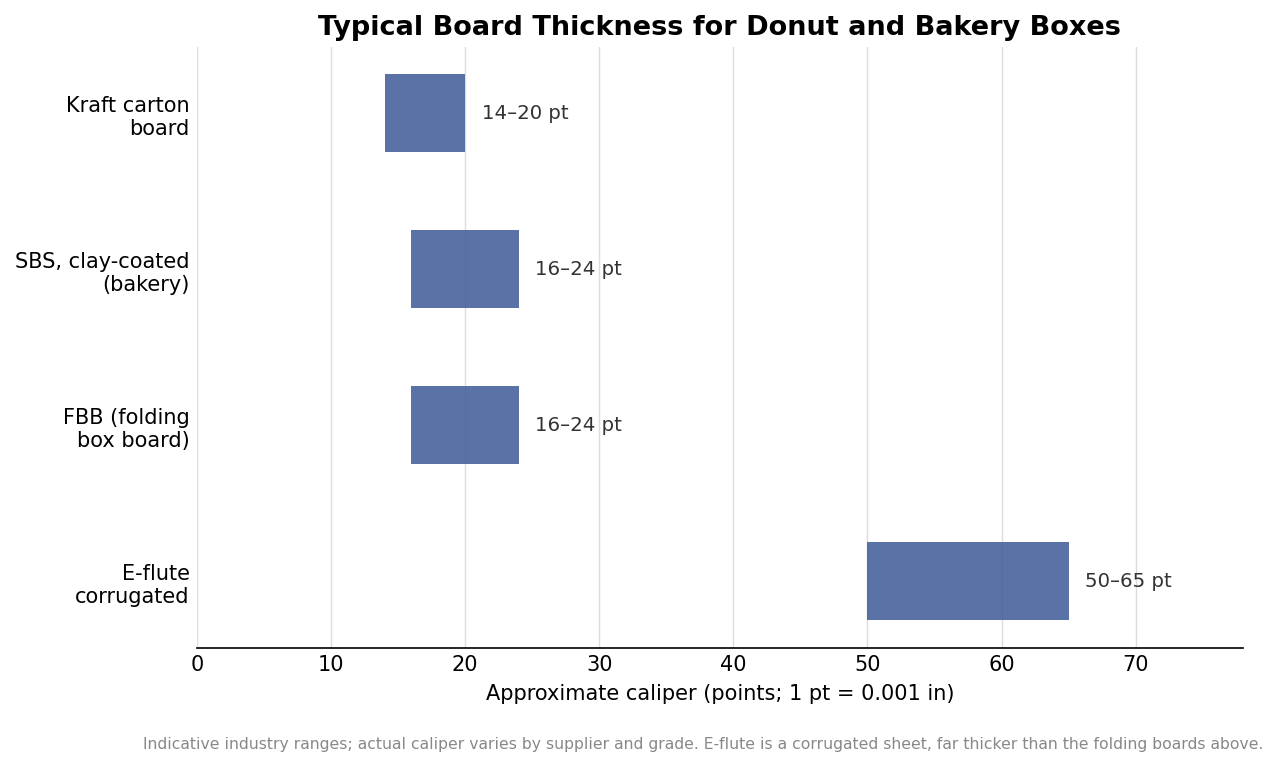
Structure and material are separate decisions, and the board you print on changes both cost and protection. Kraft carton board gives the natural, craft look and moderate grease resistance; bleached SBS, usually clay-coated, prints the cleanest full-color graphics and is the common choice for retail bakery boxes; folding box board offers a middle path; and E-flute corrugated is a different animal entirely, a fluted sheet many times thicker that you reach for only when a large catering box needs real crush strength. Caliper for the folding boards typically lands in the mid-teens to low-twenties in points, while E-flute is measured in the fifties and sixties because of its wave. Grease resistance is the other half of the material choice: glazed and filled donuts demand a grease-managing board or liner, and since 2026-era rules have pushed the industry off legacy PFAS treatments, ask suppliers specifically which PFAS-free barrier they use rather than assuming any coated board will hold up to oil.
Choosing the structure
Work from the load outward. Decide how heavy and how far the box travels, and let that pick the structure: plain tuck-top for light counter sales, auto-lock bottom for stacked or catered dozens, lock-corner for glue-free presentation, clamshell for singles, gable for gifting. Then choose the board for grease and stacking, kraft or SBS for most donut boxes and E-flute only for the big catering formats. Add a window and print last, once the structure and board are settled. When you request a quote, name the style, the board and caliper, and the closure explicitly, because a photo of the finished box hides every one of the structural differences that will decide how it performs on your busiest morning.
Leave a Reply