Category: Uncategorized

  • Setting Up Print-Ready Artwork for Custom Donut Boxes

    Setting Up Print-Ready Artwork for Custom Donut Boxes

    The fastest way to delay a custom donut box order is to send artwork the printer cannot use. A logo pulled off a website, text sitting right on the fold, a file in the wrong color mode—each one bounces back for a fix, and a box that could have shipped this week slips to next. None of it is hard to avoid once you know what a print department is actually looking for, so here is how to hand over files that go straight to press.

    Start from the dieline, not a blank rectangle

    A donut box is not a flat sheet. It is a folded structure, and the printer supplies a dieline—a template showing exactly where the box is cut, where it folds, and where the panels end up once it is assembled. Your artwork gets built on top of that template, so the front panel art lands on the front and the lid art lands on the lid rather than wrapping across a crease. Ask for the dieline before you design anything, keep its cut and fold marks on their own layer, and never resize or nudge it to make your art fit. If the layout does not work within the dieline, the design changes, not the template.

    It helps to think panel by panel rather than treating the flat template as one canvas. Sketch which artwork belongs on the lid, the front, and the sides, and remember that some panels flip or rotate once the box is folded, so text that reads correctly on the flat sheet can end up upside down on the assembled box. A quick way to catch this is to print the dieline at scale, fold a paper mock-up, and check that every element sits where you expect before you commit to the real file.

    Bleed, trim, and the safe zone

    Three boundaries do most of the work on any packaging file, and mixing them up is the most common reason art comes back. The trim line is the dieline itself—where the blade cuts. Bleed is the margin you extend background color and images past that cut line, so that a hair of misalignment on the cutter does not leave a thin white sliver at the edge. The safe zone is the opposite inset: the area, held in from the trim, where your logo and text need to stay so nothing important gets shaved off.
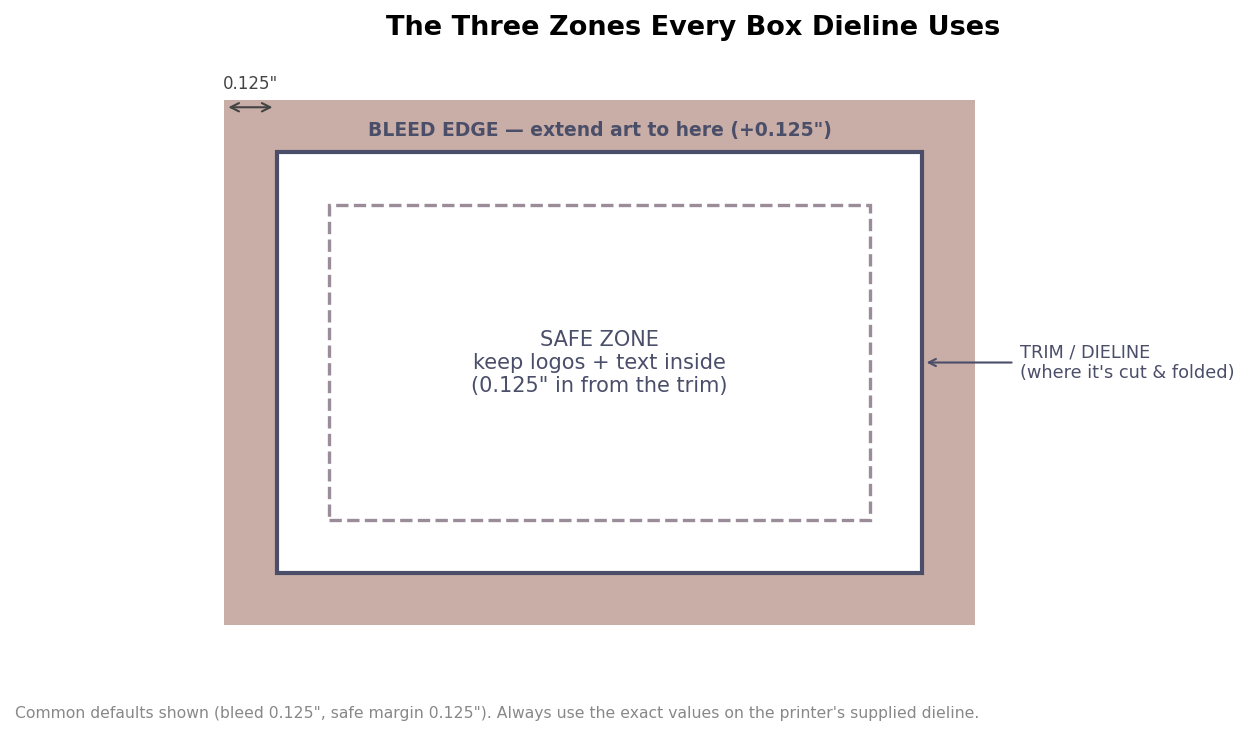
    Schematic of a box dieline showing bleed edge, trim line, and safe zone with quarter-inch margins
    Every packaging file works within three boundaries: bleed, trim, and the safe zone.

    Common defaults are an eighth of an inch of bleed beyond the trim and at least an eighth of an inch of safe margin inside it, but these are not universal. The value that matters is whatever the supplied dieline specifies, so read the template rather than assuming. The practical habit is simple: push backgrounds all the way to the bleed edge, and pull anything you cannot afford to lose comfortably inside the safe zone.

    Resolution: why a website logo will not do

    Images need to be about 300 dpi at the size they actually print on the box. The trap is that a logo saved for a website might be only a few hundred pixels wide, which looks crisp on a screen at 72 dpi but turns soft and blocky when it is stretched across a box panel. Enlarging that small file does not add detail; it only spreads the same pixels thinner.
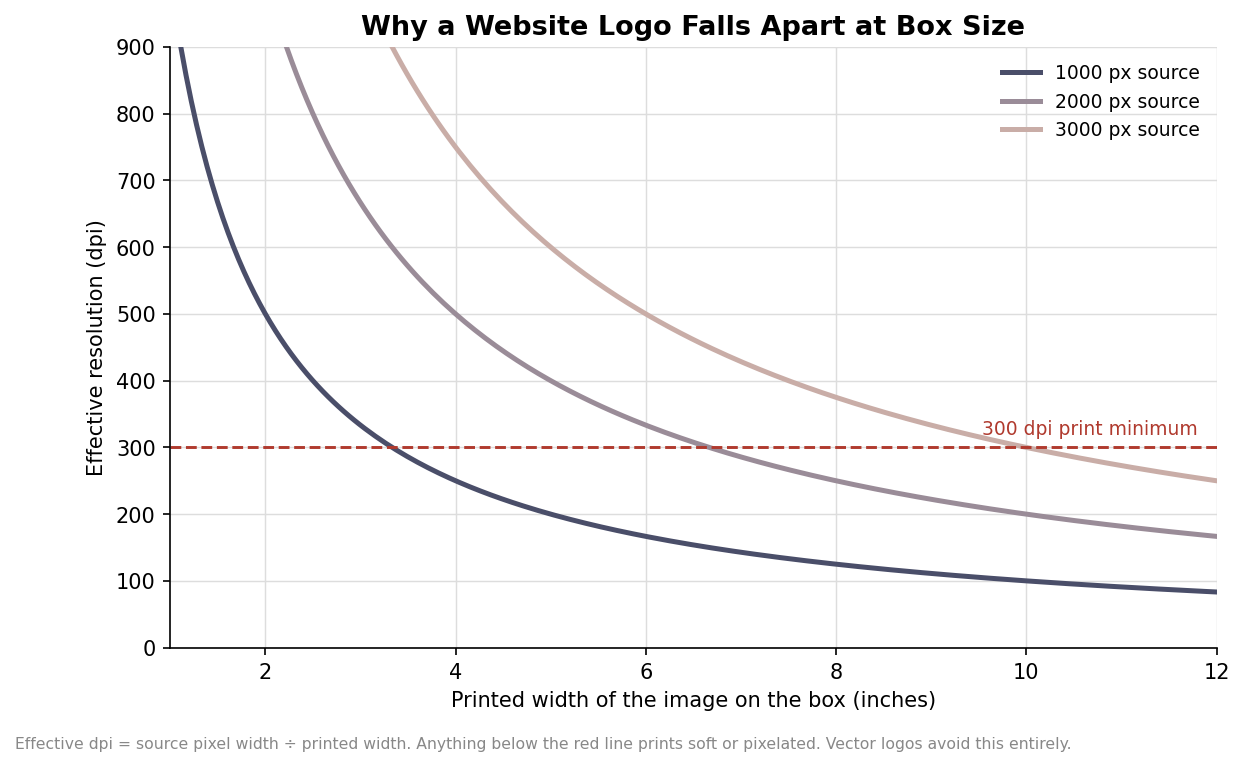
    Line chart of effective print resolution in dpi versus printed image width for different source pixel sizes
    The wider a raster image prints, the lower its effective resolution; vector art sidesteps the limit.

    The chart shows why the source file size matters: the same image printed wider drops in effective resolution fast, and once it falls under the 300-dpi line it prints fuzzy. The clean way out is to supply logos and text as vector art—built from paths rather than pixels—because vectors stay razor sharp at any size. Save photographs and vectors accordingly, and never upscale a small raster and hope it holds.

    Color: what changes between your screen and the box

    Screens build color from light in RGB, while presses build it from ink in CMYK, so a design almost always shifts when it moves from monitor to box. Set your file up in CMYK from the start rather than converting at the end, and expect bright, saturated screen colors—electric blues, vivid greens—to come back a shade more subdued. When a brand color has to match exactly across every run, call it out as a specific Pantone spot color instead of relying on process CMYK to approximate it.

    Stock changes color too. On uncoated brown kraft, ink soaks in and every color reads darker and more muted than the same ink on bright white board, which is why a design that pops on a white box can look flat on kraft. Bright colors on kraft often need a white underprint laid down first to keep them from going muddy, so if you are printing vivid art on a brown box, ask the printer whether that white base is included. The only reliable way to know how a color will land is a physical proof on the actual stock, which is always worth requesting before a large run.

    Files, fonts, and the proof

    Print departments want vector files—PDF, AI, or EPS—with fonts converted to outlines so a typeface you own does not get silently swapped for something else on a machine that lacks it. Embed any linked photos so they travel with the file, keep the dieline on its own clearly named layer, and flatten nothing you might need to edit. Then, before you approve production, look hard at the proof: check the spelling, confirm the art sits inside the safe zone on every panel, and verify the colors against your Pantone references. Ten minutes with a proof is the cheapest insurance there is, because a mistake caught on the proof costs nothing, while the same mistake caught on a delivered pallet of boxes costs the whole run.
  • Donut Box Styles Compared: Auto-Lock Bottom, Tuck-Top, Window, and Clamshell

    Donut Box Styles Compared: Auto-Lock Bottom, Tuck-Top, Window, and Clamshell

    Size and print get almost all the attention when a bakery orders custom donut boxes, but the structure quietly does the hard work. How a box folds, locks, and carries its load decides whether a dozen glazed donuts survive a delivery driver’s back seat and how many minutes your staff spend snapping boxes together during the morning rush. The styles below all show up in donut catalogs under similar photos, yet they behave differently once there is weight inside. Here is how the common structures compare and which one to specify for the way you actually sell.

    The one-piece tuck-top: the default donut box

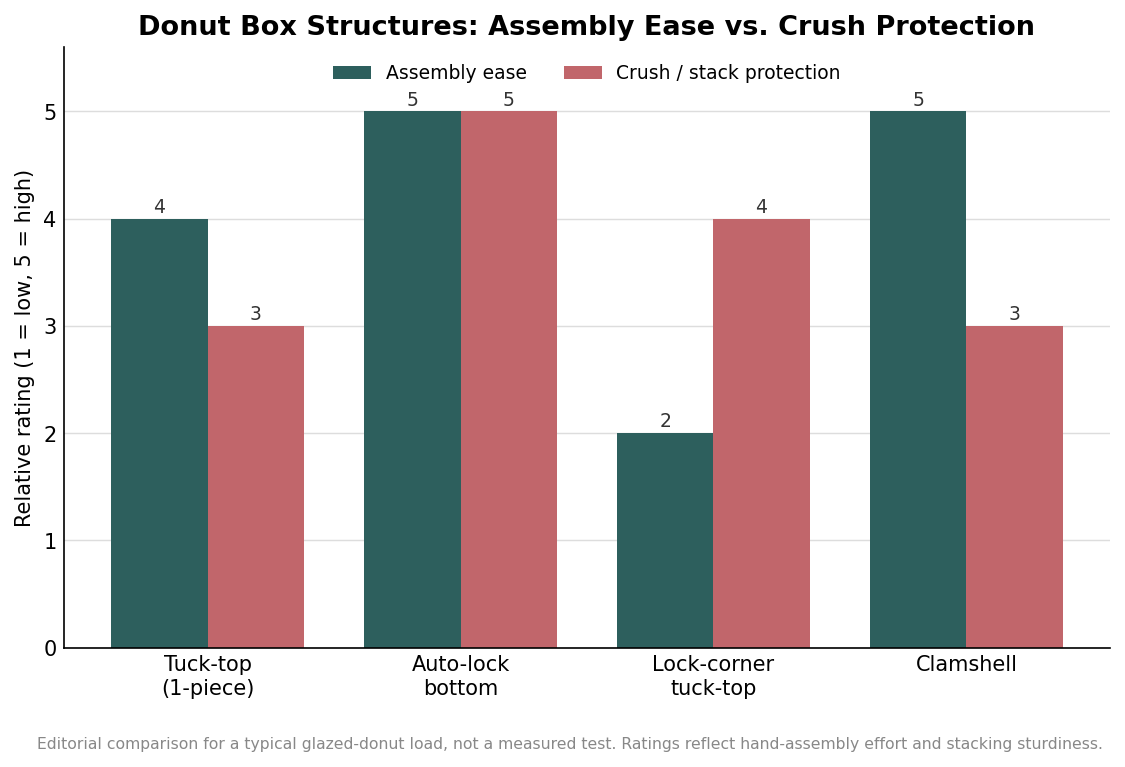
    Most bakery boxes you have handled are a one-piece tuck-top, often a roll-end style where the walls fold up from a flat blank and a front flap tucks in to close. It ships and stores flat, assembles by hand in a few folds, and costs the least per unit, which is why it dominates counter service and short trips home. The tradeoff is rigidity: with a full dozen inside and nothing locking the base, the bottom can bow if the box is carried one-handed or stacked two high. For a half-dozen going a few blocks it is more than enough; for catering runs it is the weakest of the group.

    Auto-lock bottom: built for weight and speed

    An auto-lock bottom, also called a crash-lock or one-two-three bottom, arrives pre-glued so the base snaps into a locked, load-bearing floor the moment you square the box. That single feature does two useful things at once. It gives you the sturdiest bottom in the lineup, which matters for heavier assorted dozens and for stacking, and it is the fastest to set up at volume because there is no folding sequence to teach a new hire. You pay a little more per unit for the glued construction, but a busy shop usually earns that back in assembly labor and in fewer crushed orders.

    Lock-corner tuck-top: rigid walls without glue

    A lock-corner tuck-top uses interlocking tabs at each corner to build rigid side walls with no adhesive at all. The result is a strong, clean-walled box that presents well and holds its shape, sitting between the plain tuck-top and the auto-lock bottom on sturdiness. The cost is assembly time: those corners are folded and locked by hand, which is fine for a boutique operation packing gift dozens but slows down a high-volume morning. Choose it when presentation and a glue-free build matter more than raw setup speed.

    Grouped bar chart rating four donut box structures on assembly ease and crush protection
    Auto-lock bottoms lead on both speed and sturdiness; lock-corner boxes trade assembly time for rigid walls.

    Window boxes: selling the donut through the lid

    A die-cut window turns the box into a merchandising tool, letting a decorated dozen sell itself on a shelf or in a grab-and-go cooler. The window is covered with a clear film, most commonly PET or polypropylene for clarity and low cost, with cellulose or PLA-based films available when you need a compostable claim to match the paperboard. Two things are worth planning for. A window adds cost and one more component to the build, and a warm glazed donut against cold film can fog or leave grease marks, so windows earn their keep most on cake, filled, and decorated donuts sold at room temperature rather than on hot, freshly glazed rings.

    Clamshell and gable: grab-and-go and gifting

    A clamshell is a one-piece hinged box that opens and closes in a single motion, ideal for singles, pairs, and half-dozens where speed at the counter is everything. A gable box folds up with a built-in handle and reads as a gift or party favor, which suits seasonal boxes and takeaway promotions more than a standard baker’s dozen. Neither is the workhorse for a full stacked delivery, but each solves a specific merchandising job the standard box does not.

    Board and barrier: what the structure is made of

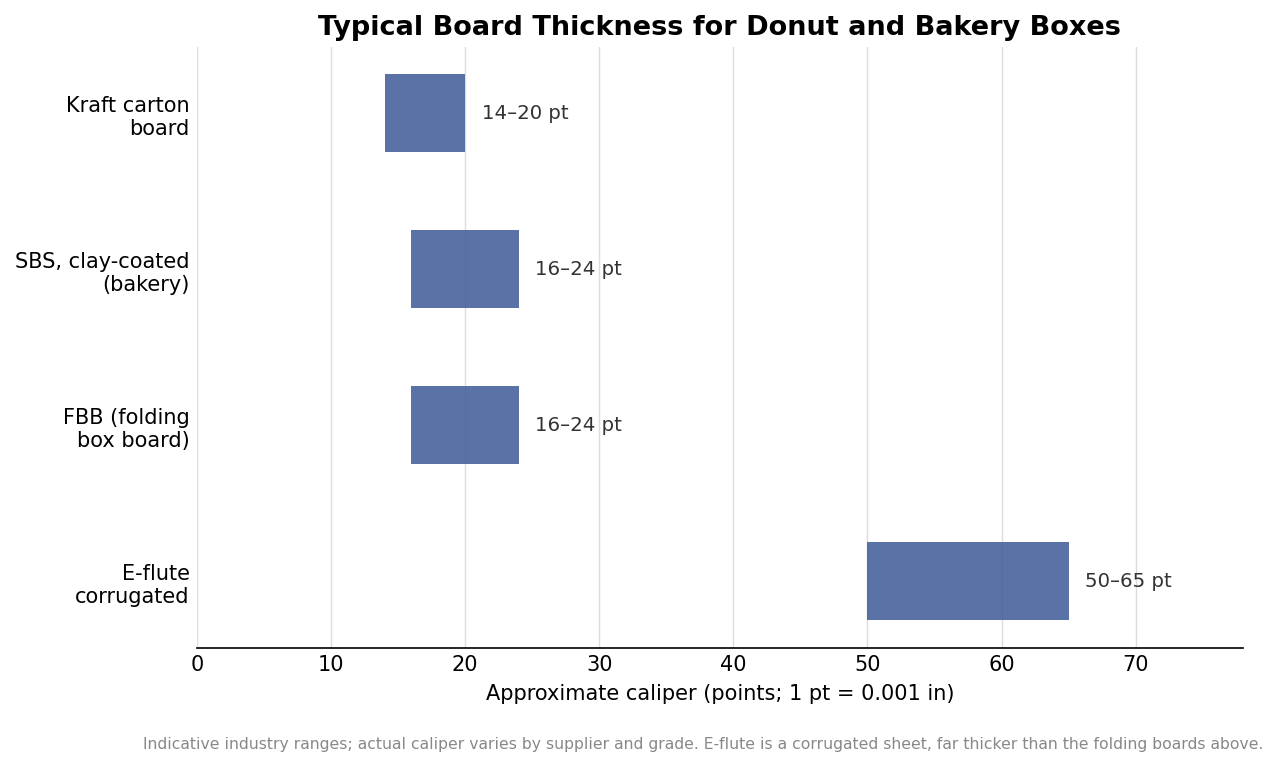
    Structure and material are separate decisions, and the board you print on changes both cost and protection. Kraft carton board gives the natural, craft look and moderate grease resistance; bleached SBS, usually clay-coated, prints the cleanest full-color graphics and is the common choice for retail bakery boxes; folding box board offers a middle path; and E-flute corrugated is a different animal entirely, a fluted sheet many times thicker that you reach for only when a large catering box needs real crush strength. Caliper for the folding boards typically lands in the mid-teens to low-twenties in points, while E-flute is measured in the fifties and sixties because of its wave. Grease resistance is the other half of the material choice: glazed and filled donuts demand a grease-managing board or liner, and since 2026-era rules have pushed the industry off legacy PFAS treatments, ask suppliers specifically which PFAS-free barrier they use rather than assuming any coated board will hold up to oil.

    Bar chart of approximate caliper ranges in points for kraft, SBS, FBB, and E-flute board
    Folding boards sit in the mid-teens to low-twenties in points; E-flute corrugated is far thicker.

    Choosing the structure

    Work from the load outward. Decide how heavy and how far the box travels, and let that pick the structure: plain tuck-top for light counter sales, auto-lock bottom for stacked or catered dozens, lock-corner for glue-free presentation, clamshell for singles, gable for gifting. Then choose the board for grease and stacking, kraft or SBS for most donut boxes and E-flute only for the big catering formats. Add a window and print last, once the structure and board are settled. When you request a quote, name the style, the board and caliper, and the closure explicitly, because a photo of the finished box hides every one of the structural differences that will decide how it performs on your busiest morning.

  • How to Ship Donuts So They Arrive Fresh: A Packaging Walkthrough

    How to Ship Donuts So They Arrive Fresh: A Packaging Walkthrough

    Mail-order donuts have turned into a real revenue line for bakeries that once sold only across the counter, and the packaging is what makes or breaks the business. A box that immobilizes a dozen donuts on the shelf can still let them slide, stack, and smear across three days in a delivery truck. Shipping donuts well is a packaging problem before it is a logistics problem, and it comes down to a few decisions you make once and then repeat on every order.

    Start with what you are actually shipping

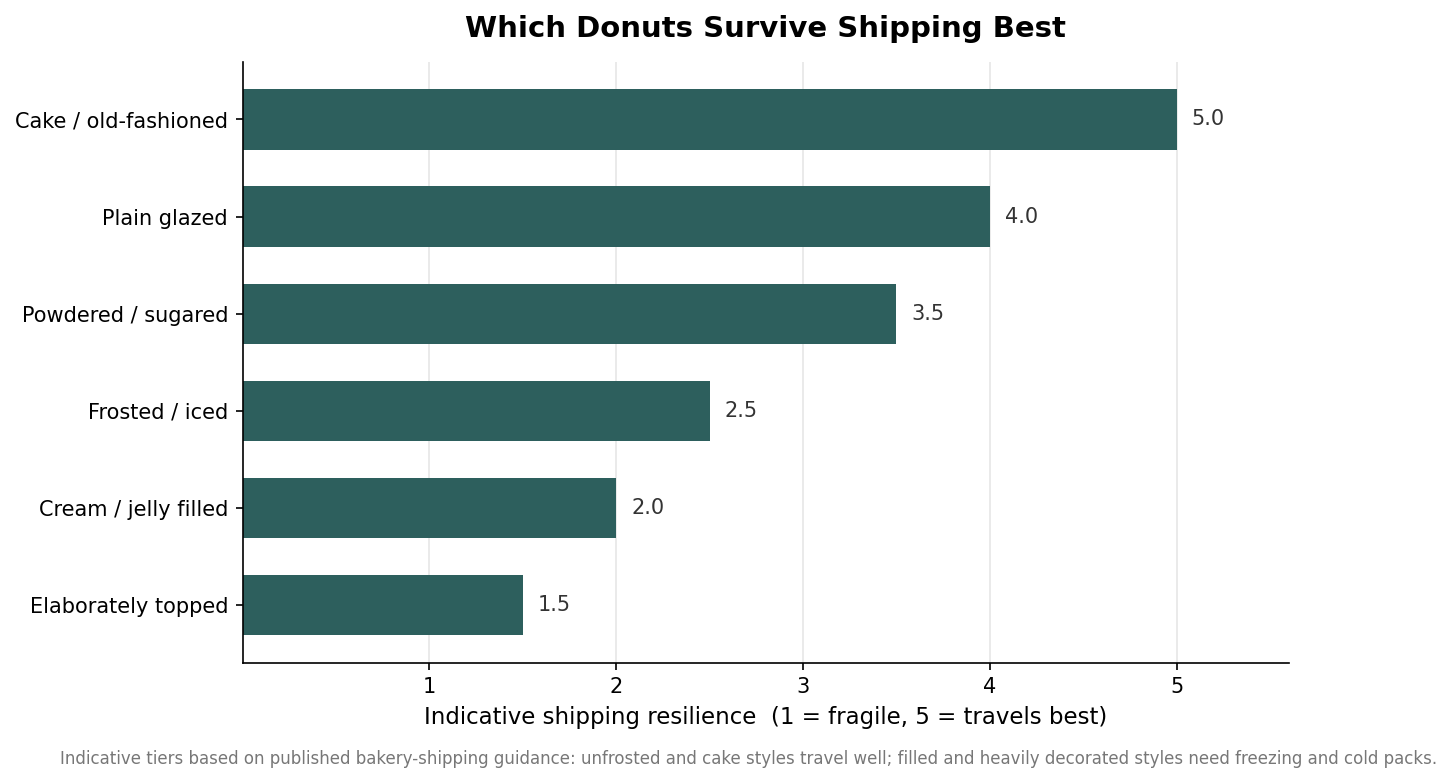
    Not every donut travels the same. Cake donuts and old-fashioned styles are dense and unfrosted, so they hold their shape and shrug off a rough ride. Plain glazed and sugared donuts do well too, with the main risk being a scuffed surface rather than a crushed one. The trouble starts with frosted, iced, and cream- or jelly-filled donuts: soft toppings transfer onto whatever they touch, fillings weep, and elaborate decorations shear off the moment the box shifts. If you are building a shippable menu from scratch, lean toward the resilient end and treat the fragile styles as items that need cold packing or that you simply do not ship.

    Horizontal bar chart ranking donut types by shipping resilience, cake highest and topped lowest
    Cake and glazed donuts travel best; filled and heavily decorated styles are the fragile end.

    Build the box in two layers

    The single most important structural rule for shipping donuts is to separate the presentation box from the shipping box. The inner box is the branded donut box the customer opens; its job is to hold each donut snugly so nothing rolls. Insert trays, individual compartments, or simple parchment dividers keep donuts from knocking into each other, and wrapping individual donuts in food-grade bags or parchment stops soft toppings from bonding to their neighbors. The outer box is a plain corrugated shipper, ideally a size up from the inner box, with the gap filled by crumpled kraft paper or bubble cushioning so the inner box cannot move. This double-box approach is the same method professional bakeries and shipping guides recommend for delicate baked goods, and it is far more forgiving than trying to make one beautiful box do both jobs. Before a box ships, give it the shake test: if you can hear or feel anything move, add fill.

    Choose a board that can take the trip

    A box that looks great on a bakery shelf is not automatically a box that survives a freight route. For the inner donut box, a sturdy paperboard in the range of roughly 14 to 18 point holds a printed lid and resists denting better than the thin stock used for grab-and-go singles, and a grease-resistant liner keeps oil from the donuts from softening the walls and dulling the print. If your donuts are glazed or filled, that grease barrier is doing structural work, not just cosmetic work, because a saturated box collapses under the weight of anything stacked on it. For the outer shipper, standard single-wall corrugated is enough for a single dozen, but two dozen or a heavy assortment is worth double-wall board, which roughly doubles the crush resistance for a few cents more per box. Match the inner box footprint closely to the shipper so you are filling a thin gap with cushioning rather than trying to stabilize a small box rattling around a large one.

    Race the clock on freshness

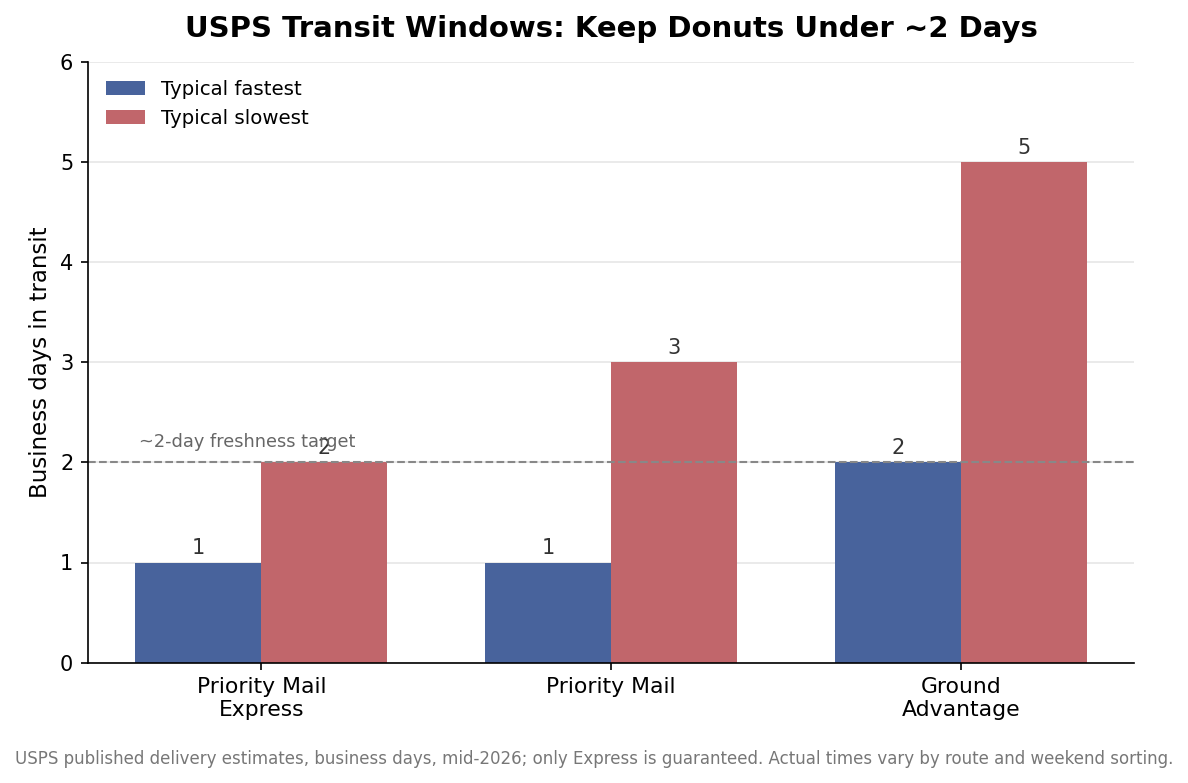
    Donuts are best within a day or two of frying, so transit time is a core packaging decision, not an afterthought. Overnight or two-day service preserves quality dramatically better than economy ground, and the practical target is to have the box in the customer’s hands within about two days of it leaving your kitchen. USPS publishes delivery estimates that make the tradeoff concrete: Priority Mail Express typically lands in one to two business days and is the only tier that is guaranteed, Priority Mail generally runs one to three, and Ground Advantage can stretch to five. Shipping early in the week also matters, because a Thursday or Friday label often means the parcel sits in a sorting facility over the weekend.

    Grouped bar chart of USPS transit windows by service against a two-day freshness target
    Only Priority Mail Express reliably stays inside a two-day freshness window.

    Add cold only when the donut demands it

    Temperature control is worth it for the fragile styles and wasted on the sturdy ones. Unfrosted cake and glazed donuts usually arrive fine with no ice at all, so adding cold packs just raises weight and cost for no benefit. For frosted, filled, or cream-based donuts going more than a day in transit, the reliable method is to freeze them solid before packing and include a cold pack, which keeps toppings set and buys time. Wrap any cold pack separately so its condensation cannot soak the donuts or the box, and remember that a wet box loses its strength fast. Cool everything to room temperature before it goes near a sealed bag, since packing a warm donut traps steam and produces exactly the sweaty, soggy surface you are trying to avoid.

    Label it so it gets handled right

    The cheapest protection you can add is information on the outside of the box. Mark shippers as perishable and as fragile or handle-with-care so carriers route and stack them accordingly, and note “this side up” when the arrangement depends on it. On the cost side, lightweight orders under a pound can move for only a few dollars on economy services, but for donuts the faster tier almost always earns its price by protecting a product you cannot replace once it arrives ruined. Specify the inner box, the outer shipper, the cushioning, and the service level once, document it, and every future order becomes a matter of following the same recipe rather than solving the problem again.

  • Why Donuts Sweat in the Box, and How Packaging Keeps Them Fresh

    Why Donuts Sweat in the Box, and How Packaging Keeps Them Fresh

    A soggy donut is almost never a baking failure. Far more often it is a packaging-and-timing failure, and the culprit is condensation: the same physics that fogs a bathroom mirror, happening inside a closed box. Fix the timing and the box, and a glazed donut that used to arrive damp and dull can reach the customer with its glaze still crisp. Here is what is actually going on, and the handful of decisions that prevent it.

    The physics in one number

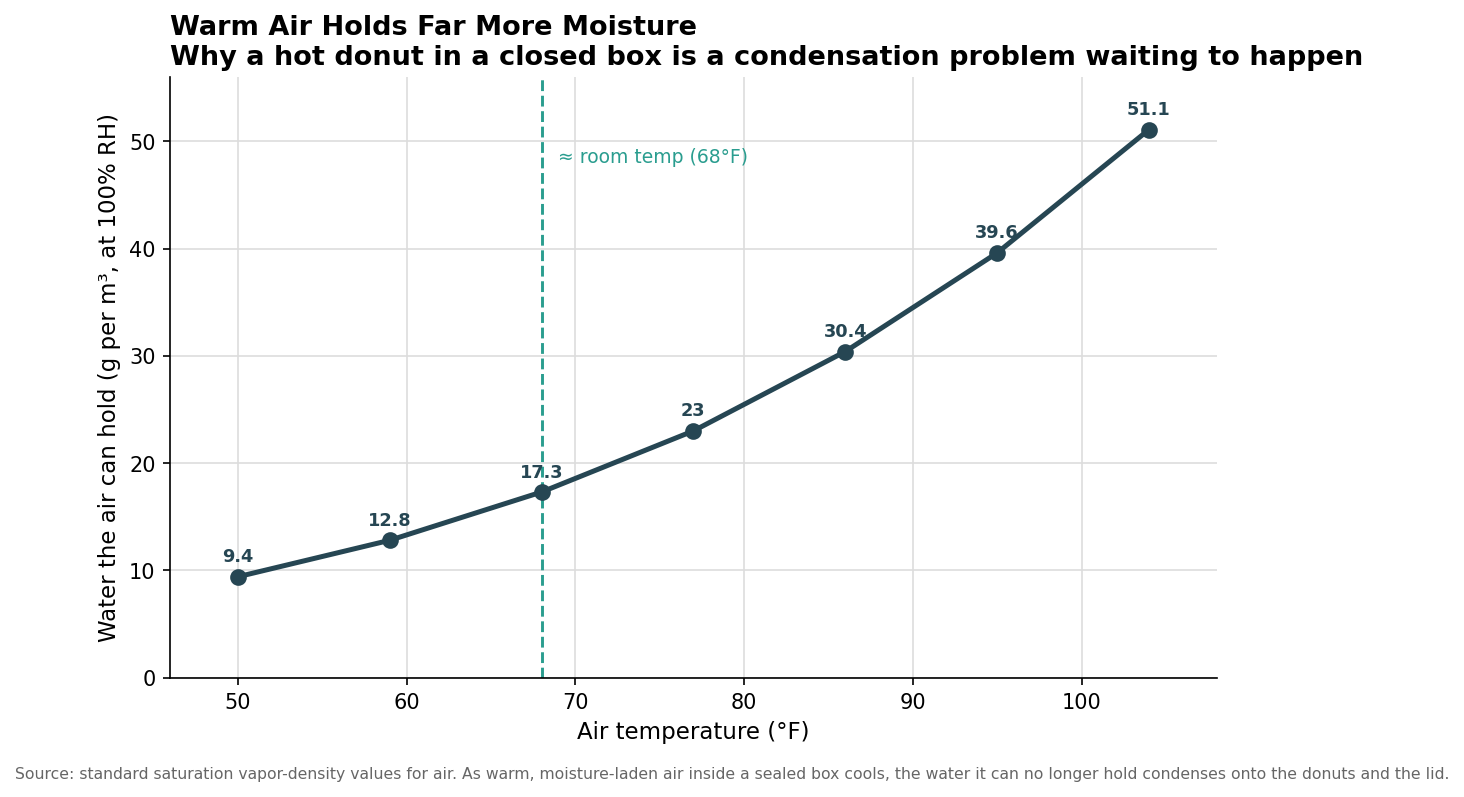
    Warm air holds far more water vapor than cool air, and the difference is not small. Air at a comfortable 68°F can hold roughly 17 grams of water per cubic meter; heat it to 95°F and that capacity jumps to about 40 grams. A freshly fried or glazed donut is warm and gives off moisture, so the air sealed around it in a closed box quickly becomes warm and humid. The trouble starts the moment that box begins to cool.

    Line chart of how much water vapor air can hold as temperature rises from 50 to 104 degrees Fahrenheit, showing capacity climbing steeply with heat
    Warm air holds far more moisture than cool air, which is why a hot, closed box condenses as it cools.

    What a hot donut does inside a closed box

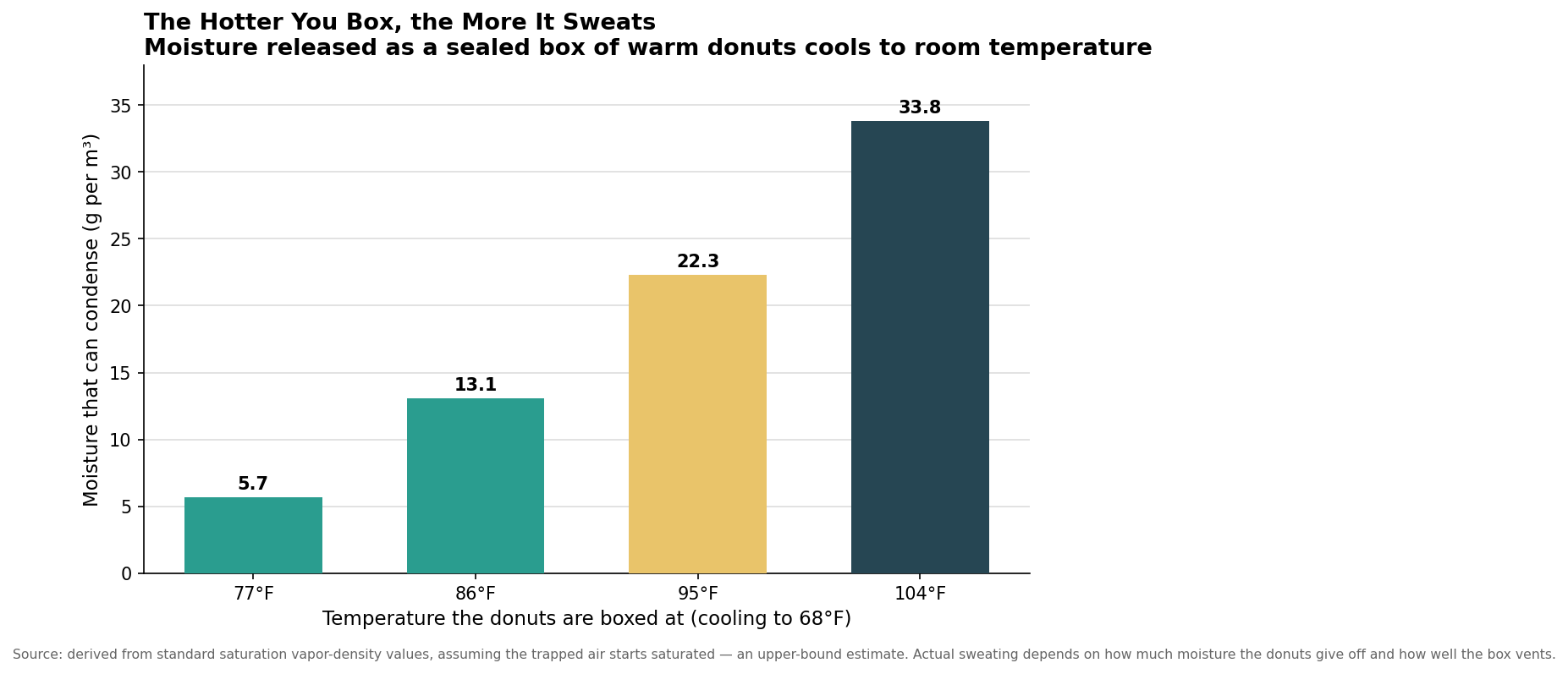
    As the trapped air cools toward room temperature, it can no longer hold all the moisture it picked up, and the excess condenses as liquid water on the coolest surfaces it can find: the underside of the lid and the donuts themselves. The hotter the donuts were when the lid went down, the more water gets released on the way to room temperature. Box donuts at 104°F and, in the worst case of fully saturated air, on the order of 30-plus grams of water per cubic meter can come back out as the box cools; box them closer to room temperature and there is very little left to condense. Glazed and sugared donuts feel it worst, because sugar is hygroscopic, meaning it actively pulls in that surrounding moisture, which is why a glaze turns from crackly to wet and runny.

    Bar chart of moisture that can condense as a sealed box of warm donuts cools to 68 degrees, rising with the boxing temperature
    The hotter donuts are when boxed, the more moisture can condense on the way to room temperature (upper-bound estimate).

    Cool before you close

    The single most effective fix costs nothing: let the donuts cool close to room temperature before you put the lid down. Cooling on a rack lets the initial burst of heat and steam escape into the room instead of into a sealed container. Exactly how long depends on the donut and your airflow, but as a practical rule the donut should no longer feel warm to the back of your hand before it is boxed; in a normal kitchen that is often on the order of fifteen to thirty minutes. For a busy counter that boxes to order, even leaving the lid open or ajar for the first few minutes after filling the box makes a visible difference, because it gives that first flush of warm, wet air somewhere to go.

    Let the box breathe

    Material is the other half of the equation, and here the instinct to reach for the most water-resistant option backfires. A rigid plastic clamshell or a fully laminated glossy box is excellent at keeping outside moisture out, but that same seal traps the donut’s own moisture inside, and a sealed humid box is exactly the condensation trap described above. Uncoated kraft and paperboard breathe: they let a little water vapor pass through the walls, which relieves the humidity instead of concentrating it. That breathability is why so many bakery boxes are simple paperboard rather than plastic, and why many designs add small ventilation holes to give excess moisture a deliberate escape route.

    The catch is grease. Donuts need a box that resists oil, so the practical target is a box that is grease-resistant on the inside but not hermetically sealed: a paperboard with a food-safe, breathable barrier rather than a full plastic laminate. If you use a window box for display, remember the window is a plastic film and behaves like the clamshell, fogging up as the box cools; look for anti-fog window film, and keep windows for short display windows rather than long, warm transit. It is a balancing act between keeping oil off the customer’s hands and letting the donut’s own steam out, and paperboard sits in that middle ground better than either extreme.

    Match the packaging to the donut

    Not every donut wants the same box. A dry cake donut or an old-fashioned is forgiving and does well in plain, breathable paperboard. A glazed or sugar-coated donut is the most condensation-sensitive and benefits most from cooling fully and from a vented, breathable box. It also helps not to stack or crowd warm glazed donuts, since pressed-together surfaces trap moisture between them and are the first spots to turn tacky. Filled and cream-topped donuts add a different problem, temperature rather than humidity, so if they must sit for a while they belong in a cool environment, not just a clever box. And there is a real difference between packaging for same-day pickup and packaging for shipping: a box that travels for a day may justify an inner liner or a food-safe insert to keep donuts from sliding and rubbing, whereas a dozen crossing the counter simply needs to breathe.

    Put together, the anti-sog routine is short. Cool the donuts until they are no longer warm to the touch, choose a grease-resistant but breathable paperboard rather than a sealed plastic shell, add ventilation where the design allows, treat windows as the fog risk they are, and close the lid only once the heat is gone. None of it changes your recipe, and all of it changes what lands in front of the customer.

  • PFAS Rules Are Reshaping Donut Boxes: A Compliance and Grease-Barrier Guide

    PFAS Rules Are Reshaping Donut Boxes: A Compliance and Grease-Barrier Guide

    If you order boxes for a bakery or cafe, the plain paperboard under your glaze has quietly become a regulatory question. The chemistry that made paper resist grease for decades — a family of fluorinated compounds known as PFAS — is being pulled out of food packaging by both regulators and manufacturers. A donut box now has to do two jobs at once: keep oil and glaze from bleeding through the walls, and do it without the coating that used to make that easy. This is a plain-language guide to what changed, how grease resistance is actually measured, and how to specify a box that is both compliant and still fit for a dozen glazed donuts.

    What PFAS did in a box, and why it is leaving

    PFAS — per- and polyfluoroalkyl substances — were widely used as an oil and grease barrier on paper and molded fiber because they work extremely well and cost little. The problem is that they are persistent, earning the nickname “forever chemicals,” and can migrate from packaging into food. That combination put them in regulators’ sights. In February 2024 the U.S. Food and Drug Administration announced that grease-proofing PFAS substances are no longer being sold for food-contact use in the United States, the result of a voluntary market phase-out. States have gone further, writing outright bans into law. The upshot for a buyer is simple: the default grease barrier of a few years ago is disappearing, and the boxes on the market are shifting to replacements whether or not you ask.

    The state patchwork you are actually buying into

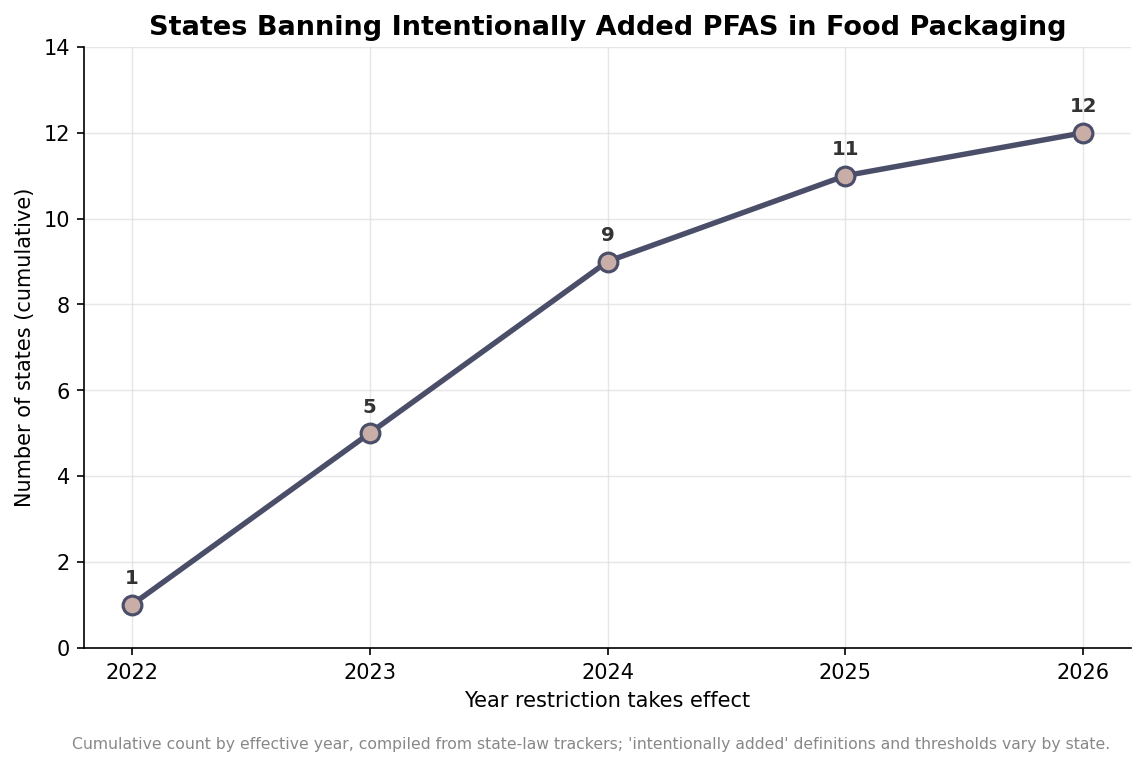
    At least twelve states have banned intentionally added PFAS in food packaging, and the effective dates are staggered. New York was first in 2022, followed by California, Washington, Vermont and Connecticut in 2023, then Colorado, Minnesota, Maryland and Hawaii in 2024, Oregon and Rhode Island in 2025, and Maine in 2026. Most laws target the “intentionally added” PFAS in plant-fiber packaging — paper, paperboard, molded fiber and bagasse — and some, such as California, back that up with a screening threshold measured as total organic fluorine, in California’s case 100 parts per million.

    The practical consequence is that even a bakery in a state with no ban is affected. If you ship mail-order boxes across state lines, sell at events in neighboring states, or simply buy from a supplier that standardizes one product line nationwide, you are effectively held to the strictest rule in the set. Manufacturers rarely maintain a compliant and a non-compliant version of the same box; they converge on the compliant one.

    Line chart showing the cumulative number of US states banning intentionally added PFAS in food packaging rising from one in 2022 to twelve in 2026
    State bans on intentionally added PFAS in food packaging have climbed from one state in 2022 to twelve by 2026.

    How grease resistance is measured: the Kit Test

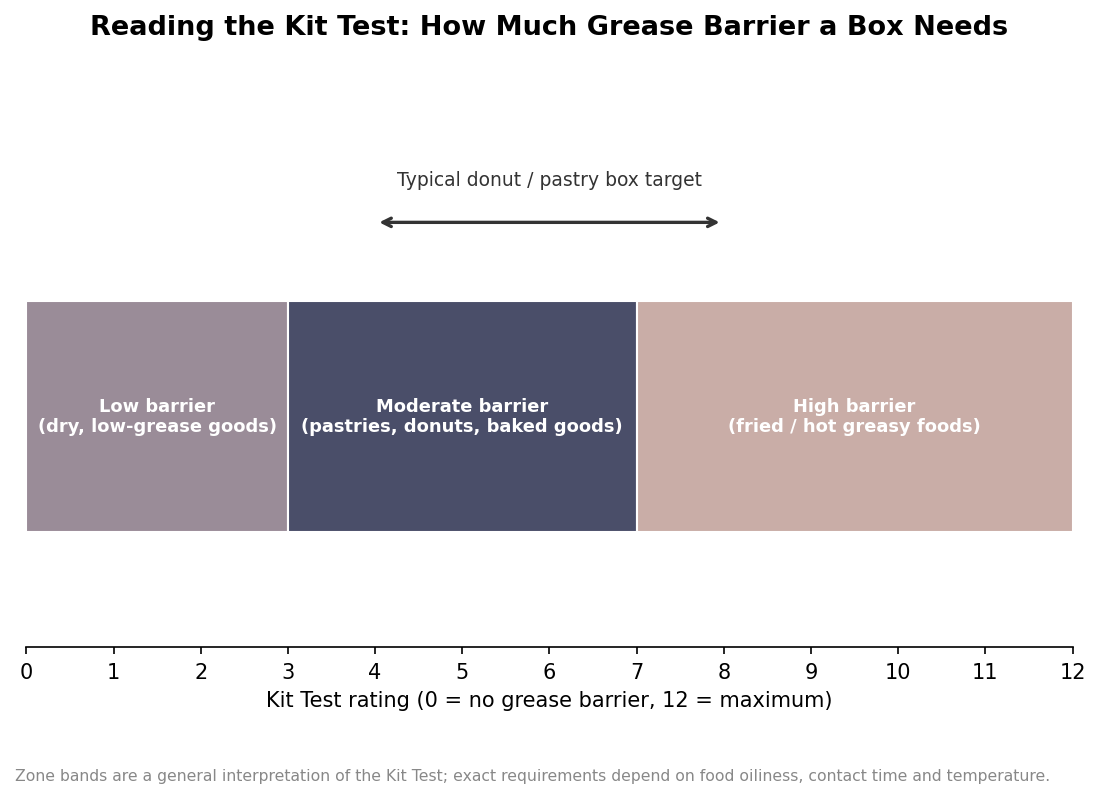
    Because the barrier is now the variable, it helps to know how it is graded. The industry standard is the Kit Test, which scores oil and grease resistance on a scale from 0 to 12, where a higher number means a stronger barrier. Dry, low-grease items need very little; fried or hot greasy foods sit at the top of the scale. Donuts and pastries land in the middle, where sugar glaze and a modest amount of oil need holding back over a short carry time but not the punishing conditions of, say, a hot fried-chicken box. When you evaluate a PFAS-free box, the useful question is not “is it coated” but “what Kit level does it hit, and is that appropriate for glazed and filled donuts.”

    Segmented horizontal scale of the Kit Test from 0 to 12 with low, moderate and high grease-barrier zones and a donut box target band around four to eight
    On the 0-to-12 Kit Test, glazed and filled donut boxes generally target the moderate-barrier band rather than the top of the scale.

    PFAS-free barriers that actually work

    The encouraging part is that the replacements have caught up. Water-based dispersion coatings — aqueous polymer and biowax formulations — are the mainstream substitute, are FDA-compliant under 21 CFR 176.170 for paper coatings, and can reach the top of the Kit scale, with some products rated a full 12 even after folding. Bio-based options built from starch, nanocellulose or shellac are advancing quickly, and clay-coated and PLA-lined boards remain common in foodservice. Each has an end-of-life profile worth checking: several water-based dispersion coatings repulp cleanly, which supports recycling, while PLA linings generally require industrial composting rather than a backyard bin or curbside recycling. It is also worth remembering that any paperboard heavily soaked with grease is often rejected by recycling programs regardless of coating, which is one more reason to match barrier strength to the actual food rather than over-specifying.

    How to specify a compliant donut box

    Turning all of this into a purchase order comes down to a few direct questions for your supplier. Ask for written confirmation of no intentionally added PFAS, ideally referencing the total-organic-fluorine screening that the stricter states use. Ask what the barrier actually is — water-based dispersion, bio-based, PLA or clay — and what grease performance it delivers, expressed as a Kit rating or at least a clear statement that it is rated for glazed and filled baked goods. Then ask about end of life, because “eco-friendly” is not a single thing: recyclable, industrially compostable and home compostable are different claims with different disposal paths, and a plastic viewing window will complicate both, so a window-free design or a compostable window is worth considering if sustainability is part of your brand promise.

    None of this requires becoming a packaging chemist. The regulatory direction is settled and moving one way, the replacement coatings are widely available and performing well, and the box that keeps glaze off your customer’s hands is the same box that keeps you on the right side of a growing list of state laws. Specify the barrier, confirm the compliance statement in writing, and match the grease rating to what you actually sell — and the paperboard under the glaze stops being a liability and goes back to being just a box.

  • Why Are Donut Boxes Pink? The Story, and How to Choose Your Own Box

    Why Are Donut Boxes Pink? The Story, and How to Choose Your Own Box

    If you have ever carried home a dozen doughnuts, there is a good chance the box was pink. Not white, not brown kraft, not printed with the shop’s name in gold, but a plain, slightly glossy pink. That color is one of the most recognizable pieces of food packaging in America, and almost nobody who buys a pink box knows why it is pink. The answer is a genuinely good story, and understanding it also happens to teach you something useful about choosing your own doughnut boxes.

    The pink box came from a price, not a designer

    The pink doughnut box traces back to Southern California in the 1970s and to Cambodian refugees who built an enormous network of independent doughnut shops across Los Angeles County. The figure most often credited is Ted Ngoy, sometimes called the Donut King, who arrived as a refugee, learned the trade, and went on to open and franchise dozens of shops while helping other Cambodian families into the business. As the widely told account goes, Ngoy or his associate Ning Yen asked their box supplier for something cheaper than the standard white bakery box, and the supplier had pink stock it could offer at a discount. The shops took the cheaper box, and because so many of the region’s doughnut stores shared the same suppliers and the same tight margins, pink spread until it became the default.

    The precise details differ from one telling to another, including the exact shade and the reason the pink stock happened to be cheaper, so it is fair to treat the specifics as folklore even though the broad outline is well documented. What is not in doubt is that the pink box was an economic decision that turned into a cultural signature.

    Why the color actually stuck

    A cheaper box explains how pink started, but not why it lasted fifty years. Part of the answer is cultural: in several Asian traditions red and pink read as lucky and auspicious, which made the color feel right rather than merely cheap to the families running the shops. Part of it is simple recognition. Once a critical mass of shops in a region used the same box, the pink box itself became a signal for fresh, independent, made-this-morning doughnuts, the opposite of a national chain’s branded packaging. For a small shop, that association is worth something, which is exactly the kind of calculation you should make when you choose your own box today.

    What pink does to your printing

    Here is where the history becomes practical. A colored base is not a neutral canvas, and this is the single most common surprise for a shop ordering custom boxes for the first time. Printing inks are semi-transparent, so any color you lay down on pink board mixes with the pink underneath it. A navy logo skews toward purple, a yellow all but disappears, and a full-color photograph prints muddy and warm because there is no white beneath the ink to make the colors read true. That is precisely why the classic pink box carries only a simple one-color stamp, often in red, maroon, or black, chosen because it still looks clean on a pink ground. If your brand lives on a specific blue or a photographic design, you generally cannot get it accurate on pink board; you either choose one or two spot colors that are designed to sit on pink, or you print on a white coated box where the inks reproduce faithfully. Deciding that before you send artwork saves a frustrating sample round.

    Pink, kraft, or white: choosing your base

    Think of the base color as a branding decision with a cost attached rather than an afterthought. Pink and kraft blanks are the cheapest tier because they are bought plain and printed lightly or not at all, and they carry a friendly, independent, low-overhead signal. White coated board costs a little more but is the right surface for full-color and photographic printing, so it suits a brand that wants its packaging to look designed. Grease resistance depends less on color than on the coating: most doughnut boxes rely on a light clay coating and on getting the product to the customer quickly, and none of them are meant to hold a warm, glazed dozen for hours without some softening or grease-through, so match your holding time to the box rather than expecting any paperboard to be waterproof.

    What it costs, and when custom pays off

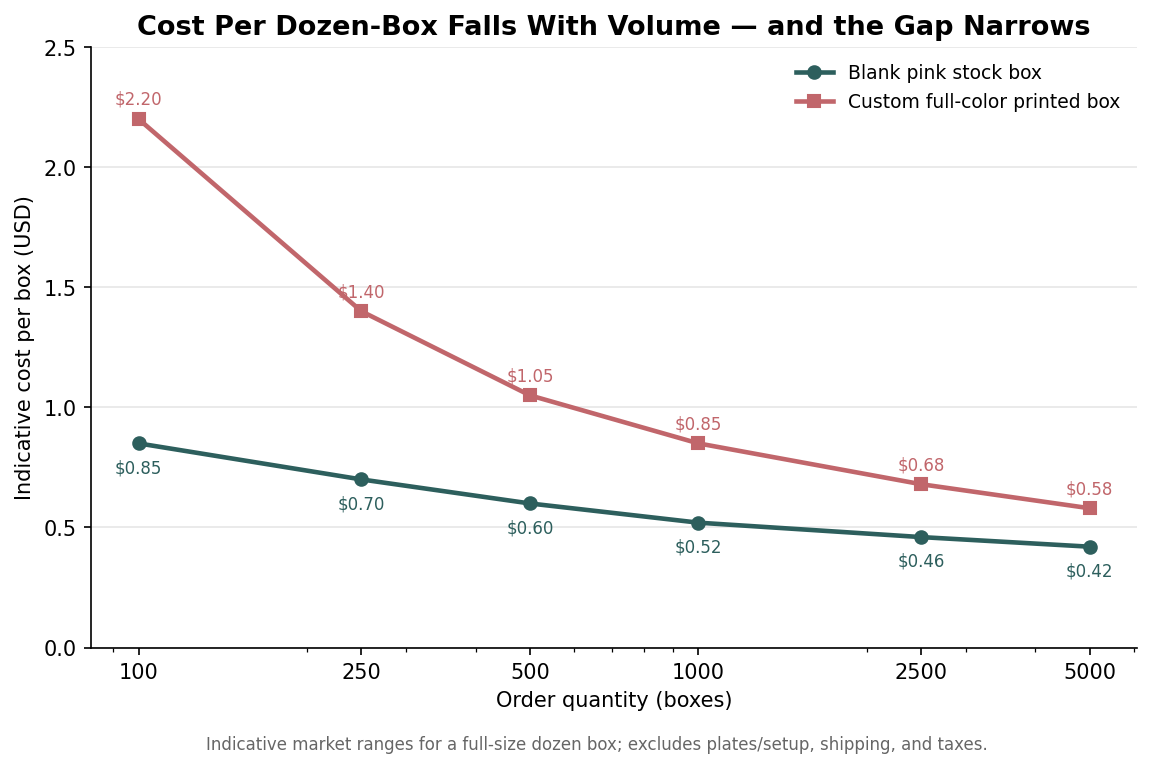
    Custom printing only makes sense at the right volume, and the math is worth seeing before you commit. Per-box cost falls steeply as quantity rises, and the premium for a full-color custom box over a plain pink blank shrinks as you scale, because the fixed costs of plates and setup spread across more units. At a hundred boxes a custom printed dozen box can cost several times what a blank pink one does; by a few thousand boxes the two are far closer. The chart below shows that curve with indicative figures so you can find the point where printing your own brand stops being a luxury.

    Line chart of indicative cost per donut box versus order quantity for blank pink versus custom full-color boxes
    Per-box cost falls with volume, and the gap between blank pink and custom-printed boxes narrows as you scale.

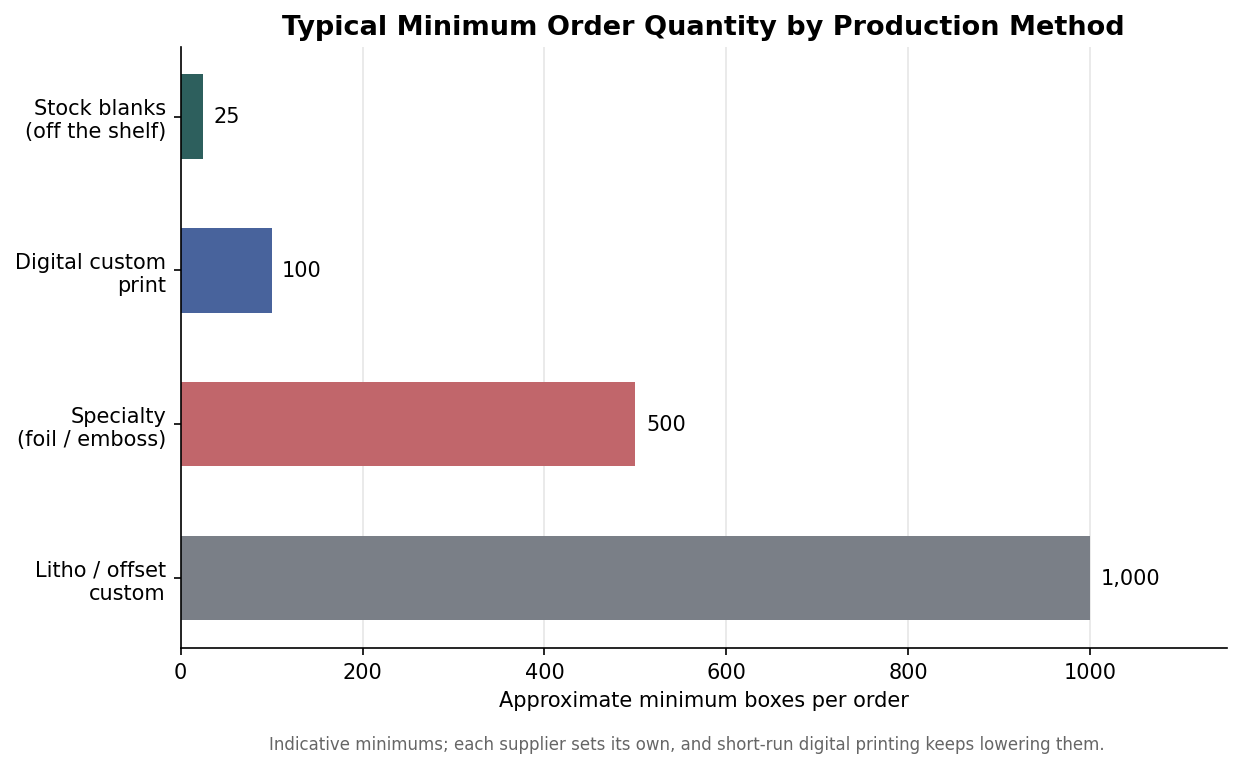
    Quantity also determines whether a printer will take your job at all, because minimums vary sharply by production method. Off-the-shelf blanks can be bought in small packs, short-run digital printing has brought custom minimums down to the low hundreds, and traditional offset or specialty finishes like foil still expect larger runs. The second chart lays out typical minimums so you can aim your order at a method that fits your volume rather than being told after the fact that you have to buy a thousand boxes.

    Horizontal bar chart of typical minimum order quantity by production method for donut boxes
    Typical minimum order quantities by production method, from off-the-shelf blanks to offset printing.

    So the pink box is not just a quirk of history; it is a lesson in packaging economics that still applies. It became the standard because it was cheap, it endured because it was recognizable, and the same two forces, cost and recognition, are exactly what you are balancing when you decide whether your own doughnuts go out in a plain pink box or a printed one with your name on it.

  • How Many Donut Boxes to Order

    HomeBlog › How Many Donut Boxes Should You Order?

    Ordering

    How Many Donut Boxes Should You Order?

    07/01/2026

    Ordering too few donut boxes means a mid-week scramble for plain stock-outs; ordering too many ties up cash in a back room. The good news is that donut box quantity math is simple once you know your weekly sell-through.

    Start with your average daily dozen-equivalent sales, multiply by the weeks of buffer you want on hand, and round up to your style’s minimum order quantity.

    The basic formula

    Take your average number of boxed sales per day (Full-Dozen, Half-Dozen, and Mini combined, converted to a common unit), multiply by 30 for a month of coverage, and add 15–20% for a holiday or weekend spike. Most single-location shops land comfortably inside our 250-box minimum for a first order.

    Shop sizeTypical monthly boxesSuggested first order
    New single location150–400250 (minimum)
    Established single location500–1,2001,000–1,500
    2–5 location group2,000–6,0003,000–5,000
    Franchise / wholesale10,000+10,000–25,000

    Account for seasonality

    Holiday weeks (back-to-school, winter holidays, Valentine’s Day) can double normal box volume for a week or two. Rather than over-ordering for the whole quarter, place a standing order sized for your normal weeks and a smaller top-up order two to three weeks ahead of a known spike — well within our standard lead time.

    Key takeawayOrder for your average month plus a 15–20% buffer, and place a seasonal top-up order two to three weeks ahead of a known rush.

    Ready to size your first order? Get a custom quote — free mockups in 24–48 hours. Learn more about how we work, or browse more guides.

    More posts

  • Full-Color Print vs. Kraft Stamp Donut Boxes

    HomeBlog › Full-Color Print vs. Kraft Stamp Donut Boxes

    Buyer guides

    Full-Color Print vs. Kraft Stamp Donut Boxes

    06/17/2026

    The single biggest decision on a custom donut box order isn’t size — it’s decoration. Full-color print and kraft stamping solve different problems, and picking the wrong one either overspends your budget or undersells your brand.

    Here is how the two compare across the factors that actually matter for a working bakery.

    Head to head

    FactorFull-color printKraft stamp
    Best forPhoto, gradients, multi-color logos, rebrandsSimple one- or two-color marks, rustic/eco brands
    Cost at volumeHigher per unitLower per unit
    Lead time2–3 weeks~2 weeks
    LookPolished, campaign-readyHandmade, artisanal

    When full-color wins

    If your brand identity depends on specific colors, a photograph, or detailed line art, a stamp physically cannot reproduce it — a stamp is one or two flat ink colors. Full-color offset print covers the entire box edge to edge and is the only way to guarantee an exact brand match, which matters most during a launch or a franchise-wide rollout.

    When kraft stamp wins

    If your logo is a simple wordmark or icon and your brand story leans into small-batch, handmade, or eco-conscious positioning, a stamp on natural kraft often reads as more authentic than a glossy full-color wrap — and it costs meaningfully less at high weekly volumes.

    Key takeawayChoose full-color for a detailed or multi-color brand identity; choose kraft stamp for a simple mark and a lower cost per box.

    Not sure which fits your brand? Get a custom quote and we’ll recommend a decoration method with your free mockup. See our full product lineup or read more guides.

    More posts

  • Custom Donut Boxes as Corporate Gifts

    HomeBlog › Custom Donut Boxes as Corporate Gifts

    Corporate

    Custom Donut Boxes as Corporate Gifts

    06/03/2026

    Corporate gifting budgets get spent on a lot of forgettable things — branded pens, stress balls, generic fruit baskets. A box of fresh donuts wrapped in your client’s or your own brand’s packaging does something those gifts don’t: it gets opened immediately, shared with an entire office, and photographed for a group chat.

    For catering companies, agencies, and bakeries running a B2B gifting program, the box itself is doing real marketing work.

    Why it works better than the usual gift

    Food gifts have near-100% “open rate” — nobody leaves a box of donuts in a drawer. A branded box adds a second layer: everyone in the office sees the logo while the box sits on the break-room counter, and the unboxing moment (a full-color printed lid, a ribbon accent) makes the gift feel considered rather than transactional.

    Structuring a gifting program

    Most gifting clients standardize on one box style — typically our Full-Dozen or Full-Color Printed box — and keep a small standing inventory so a same-week gift doesn’t wait on a new production run. Combine that with a set delivery radius and a simple order form for your sales or account team, and a donut gifting program can run with almost no manual coordination.

    Key takeawayA branded box turns a routine gift into a shared office moment — keep a standing inventory of one box style to make gifting frictionless for your team.

    Ready to set up a corporate gifting box? Get a custom quote — free mockups in 24–48 hours. Read more on our Full-Color Printed Bakery Box page, or browse more guides.

    More posts

  • Custom Donut Boxes for Wedding Favors and Donut Walls

    HomeBlog › Custom Donut Boxes for Wedding Favors and Donut Walls

    Weddings

    Custom Donut Boxes for Wedding Favors and Donut Walls

    05/20/2026

    Donut walls have become a fixture of modern wedding dessert tables, and the boxes that go with them — whether displaying the wall or sending guests home with favors — are one of the easiest ways to tie the dessert table into the couple’s color palette.

    Here is how event planners and bakeries typically approach a wedding donut box order.

    Favor boxes vs. display boxes

    Favor-sized Mini boxes (one or two donuts) are the most common wedding order — sized for a guest to take home, and printed in the couple’s wedding colors or monogram rather than a bakery’s logo. Larger Half-Dozen Window boxes are popular for the dessert table itself, where the window lets guests see the donuts before the wall is fully assembled.

    Color matching and timing

    Pastel colorways — pink, baby blue, mint — print especially well for wedding orders, and we can Pantone-match a specific palette on request. Because wedding dates are fixed and non-negotiable, we recommend finalizing artwork at least four weeks out so there is room for the standard two-to-three week production window plus a buffer for the inevitable last-minute guest-count change.

    Key takeawayOrder Mini favor boxes in your wedding colors and lock artwork at least four weeks before the date to leave a safety buffer.

    Planning a wedding order? Get a custom quote and mention your event date so we can confirm timing. See the Mini Donut Box or browse more guides.

    More posts