A soggy donut is almost never a baking failure. Far more often it is a packaging-and-timing failure, and the culprit is condensation: the same physics that fogs a bathroom mirror, happening inside a closed box. Fix the timing and the box, and a glazed donut that used to arrive damp and dull can reach the customer with its glaze still crisp. Here is what is actually going on, and the handful of decisions that prevent it.
The physics in one number
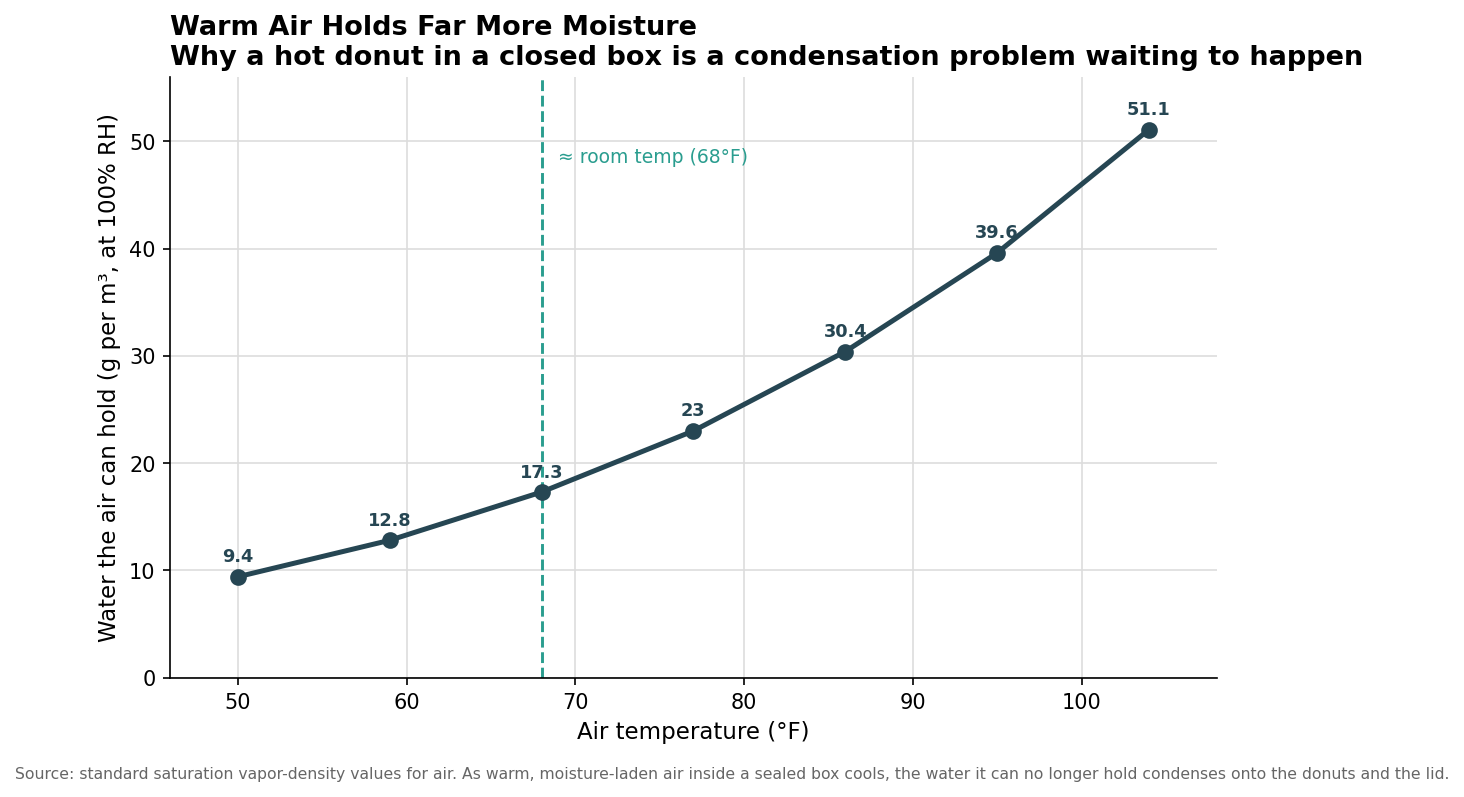
Warm air holds far more water vapor than cool air, and the difference is not small. Air at a comfortable 68°F can hold roughly 17 grams of water per cubic meter; heat it to 95°F and that capacity jumps to about 40 grams. A freshly fried or glazed donut is warm and gives off moisture, so the air sealed around it in a closed box quickly becomes warm and humid. The trouble starts the moment that box begins to cool.
What a hot donut does inside a closed box
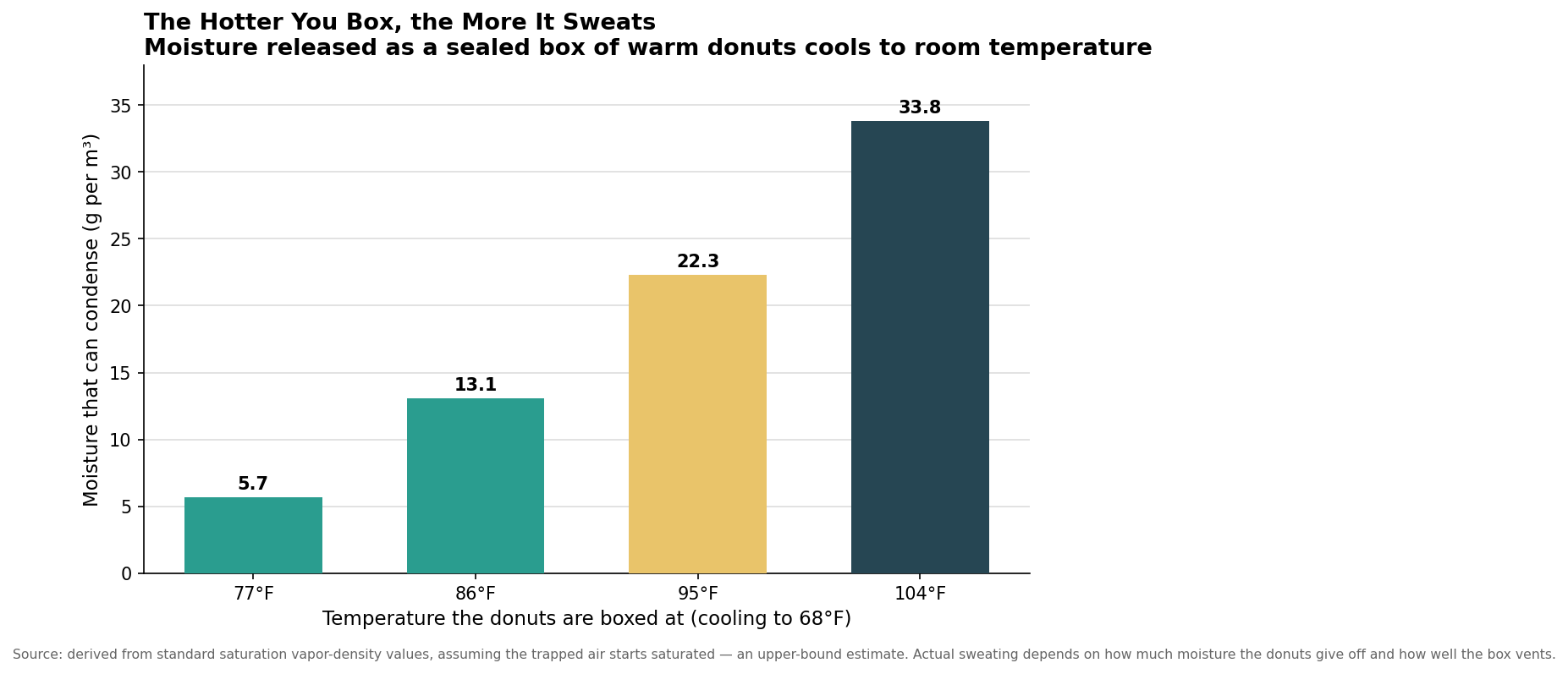
As the trapped air cools toward room temperature, it can no longer hold all the moisture it picked up, and the excess condenses as liquid water on the coolest surfaces it can find: the underside of the lid and the donuts themselves. The hotter the donuts were when the lid went down, the more water gets released on the way to room temperature. Box donuts at 104°F and, in the worst case of fully saturated air, on the order of 30-plus grams of water per cubic meter can come back out as the box cools; box them closer to room temperature and there is very little left to condense. Glazed and sugared donuts feel it worst, because sugar is hygroscopic, meaning it actively pulls in that surrounding moisture, which is why a glaze turns from crackly to wet and runny.
Cool before you close
The single most effective fix costs nothing: let the donuts cool close to room temperature before you put the lid down. Cooling on a rack lets the initial burst of heat and steam escape into the room instead of into a sealed container. Exactly how long depends on the donut and your airflow, but as a practical rule the donut should no longer feel warm to the back of your hand before it is boxed; in a normal kitchen that is often on the order of fifteen to thirty minutes. For a busy counter that boxes to order, even leaving the lid open or ajar for the first few minutes after filling the box makes a visible difference, because it gives that first flush of warm, wet air somewhere to go.
Let the box breathe
Material is the other half of the equation, and here the instinct to reach for the most water-resistant option backfires. A rigid plastic clamshell or a fully laminated glossy box is excellent at keeping outside moisture out, but that same seal traps the donut’s own moisture inside, and a sealed humid box is exactly the condensation trap described above. Uncoated kraft and paperboard breathe: they let a little water vapor pass through the walls, which relieves the humidity instead of concentrating it. That breathability is why so many bakery boxes are simple paperboard rather than plastic, and why many designs add small ventilation holes to give excess moisture a deliberate escape route.
The catch is grease. Donuts need a box that resists oil, so the practical target is a box that is grease-resistant on the inside but not hermetically sealed: a paperboard with a food-safe, breathable barrier rather than a full plastic laminate. If you use a window box for display, remember the window is a plastic film and behaves like the clamshell, fogging up as the box cools; look for anti-fog window film, and keep windows for short display windows rather than long, warm transit. It is a balancing act between keeping oil off the customer’s hands and letting the donut’s own steam out, and paperboard sits in that middle ground better than either extreme.
Match the packaging to the donut
Not every donut wants the same box. A dry cake donut or an old-fashioned is forgiving and does well in plain, breathable paperboard. A glazed or sugar-coated donut is the most condensation-sensitive and benefits most from cooling fully and from a vented, breathable box. It also helps not to stack or crowd warm glazed donuts, since pressed-together surfaces trap moisture between them and are the first spots to turn tacky. Filled and cream-topped donuts add a different problem, temperature rather than humidity, so if they must sit for a while they belong in a cool environment, not just a clever box. And there is a real difference between packaging for same-day pickup and packaging for shipping: a box that travels for a day may justify an inner liner or a food-safe insert to keep donuts from sliding and rubbing, whereas a dozen crossing the counter simply needs to breathe.
Put together, the anti-sog routine is short. Cool the donuts until they are no longer warm to the touch, choose a grease-resistant but breathable paperboard rather than a sealed plastic shell, add ventilation where the design allows, treat windows as the fog risk they are, and close the lid only once the heat is gone. None of it changes your recipe, and all of it changes what lands in front of the customer.
Leave a Reply