If you order boxes for a bakery or cafe, the plain paperboard under your glaze has quietly become a regulatory question. The chemistry that made paper resist grease for decades — a family of fluorinated compounds known as PFAS — is being pulled out of food packaging by both regulators and manufacturers. A donut box now has to do two jobs at once: keep oil and glaze from bleeding through the walls, and do it without the coating that used to make that easy. This is a plain-language guide to what changed, how grease resistance is actually measured, and how to specify a box that is both compliant and still fit for a dozen glazed donuts.
What PFAS did in a box, and why it is leaving
PFAS — per- and polyfluoroalkyl substances — were widely used as an oil and grease barrier on paper and molded fiber because they work extremely well and cost little. The problem is that they are persistent, earning the nickname “forever chemicals,” and can migrate from packaging into food. That combination put them in regulators’ sights. In February 2024 the U.S. Food and Drug Administration announced that grease-proofing PFAS substances are no longer being sold for food-contact use in the United States, the result of a voluntary market phase-out. States have gone further, writing outright bans into law. The upshot for a buyer is simple: the default grease barrier of a few years ago is disappearing, and the boxes on the market are shifting to replacements whether or not you ask.
The state patchwork you are actually buying into
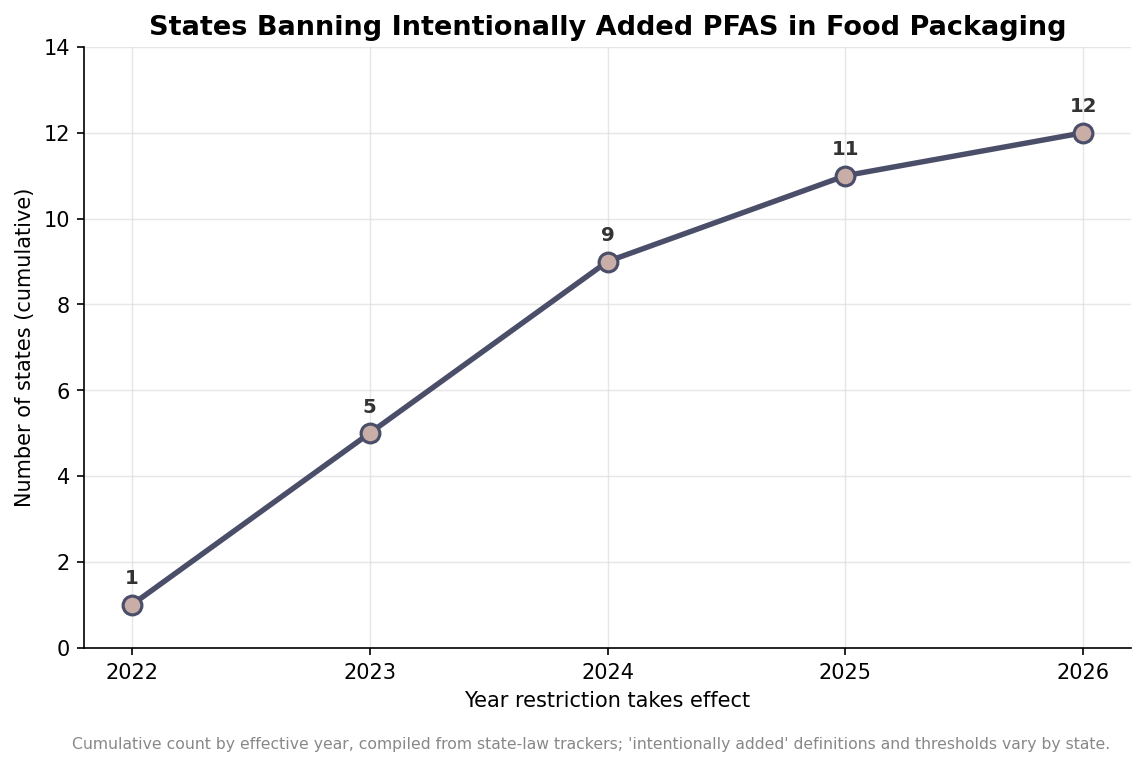
At least twelve states have banned intentionally added PFAS in food packaging, and the effective dates are staggered. New York was first in 2022, followed by California, Washington, Vermont and Connecticut in 2023, then Colorado, Minnesota, Maryland and Hawaii in 2024, Oregon and Rhode Island in 2025, and Maine in 2026. Most laws target the “intentionally added” PFAS in plant-fiber packaging — paper, paperboard, molded fiber and bagasse — and some, such as California, back that up with a screening threshold measured as total organic fluorine, in California’s case 100 parts per million.
The practical consequence is that even a bakery in a state with no ban is affected. If you ship mail-order boxes across state lines, sell at events in neighboring states, or simply buy from a supplier that standardizes one product line nationwide, you are effectively held to the strictest rule in the set. Manufacturers rarely maintain a compliant and a non-compliant version of the same box; they converge on the compliant one.
How grease resistance is measured: the Kit Test
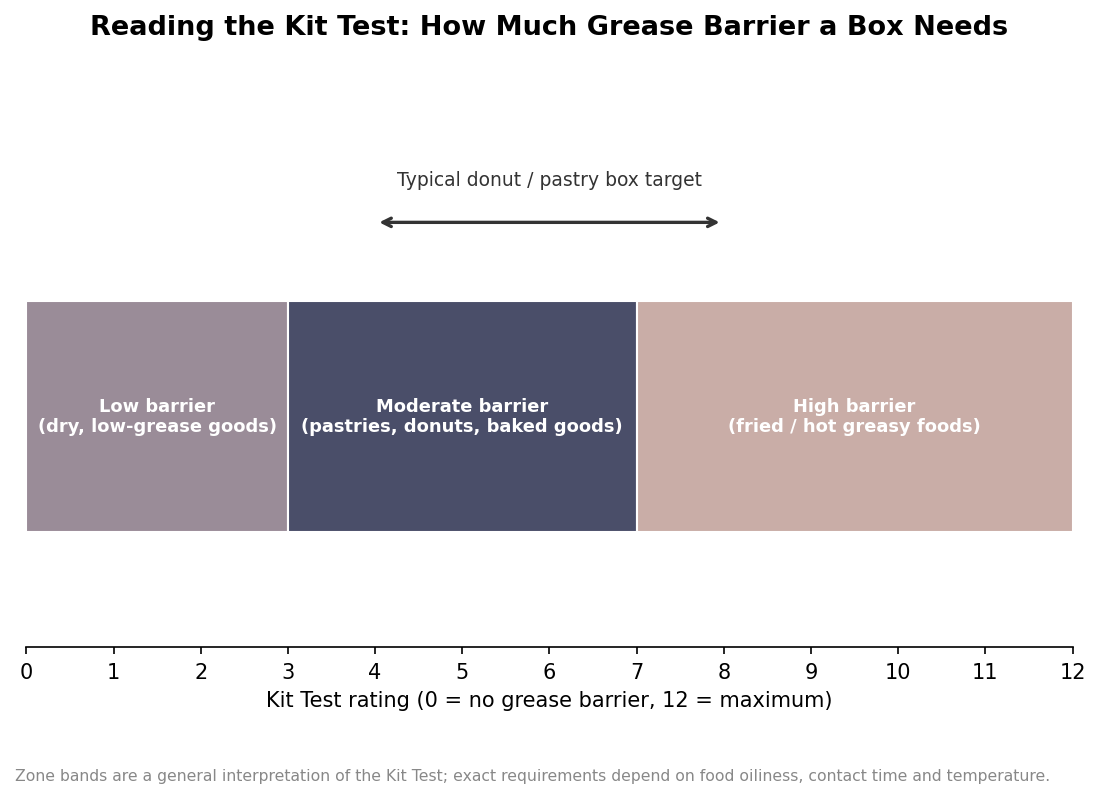
Because the barrier is now the variable, it helps to know how it is graded. The industry standard is the Kit Test, which scores oil and grease resistance on a scale from 0 to 12, where a higher number means a stronger barrier. Dry, low-grease items need very little; fried or hot greasy foods sit at the top of the scale. Donuts and pastries land in the middle, where sugar glaze and a modest amount of oil need holding back over a short carry time but not the punishing conditions of, say, a hot fried-chicken box. When you evaluate a PFAS-free box, the useful question is not “is it coated” but “what Kit level does it hit, and is that appropriate for glazed and filled donuts.”
PFAS-free barriers that actually work
The encouraging part is that the replacements have caught up. Water-based dispersion coatings — aqueous polymer and biowax formulations — are the mainstream substitute, are FDA-compliant under 21 CFR 176.170 for paper coatings, and can reach the top of the Kit scale, with some products rated a full 12 even after folding. Bio-based options built from starch, nanocellulose or shellac are advancing quickly, and clay-coated and PLA-lined boards remain common in foodservice. Each has an end-of-life profile worth checking: several water-based dispersion coatings repulp cleanly, which supports recycling, while PLA linings generally require industrial composting rather than a backyard bin or curbside recycling. It is also worth remembering that any paperboard heavily soaked with grease is often rejected by recycling programs regardless of coating, which is one more reason to match barrier strength to the actual food rather than over-specifying.
How to specify a compliant donut box
Turning all of this into a purchase order comes down to a few direct questions for your supplier. Ask for written confirmation of no intentionally added PFAS, ideally referencing the total-organic-fluorine screening that the stricter states use. Ask what the barrier actually is — water-based dispersion, bio-based, PLA or clay — and what grease performance it delivers, expressed as a Kit rating or at least a clear statement that it is rated for glazed and filled baked goods. Then ask about end of life, because “eco-friendly” is not a single thing: recyclable, industrially compostable and home compostable are different claims with different disposal paths, and a plastic viewing window will complicate both, so a window-free design or a compostable window is worth considering if sustainability is part of your brand promise.
None of this requires becoming a packaging chemist. The regulatory direction is settled and moving one way, the replacement coatings are widely available and performing well, and the box that keeps glaze off your customer’s hands is the same box that keeps you on the right side of a growing list of state laws. Specify the barrier, confirm the compliance statement in writing, and match the grease rating to what you actually sell — and the paperboard under the glaze stops being a liability and goes back to being just a box.
Leave a Reply